
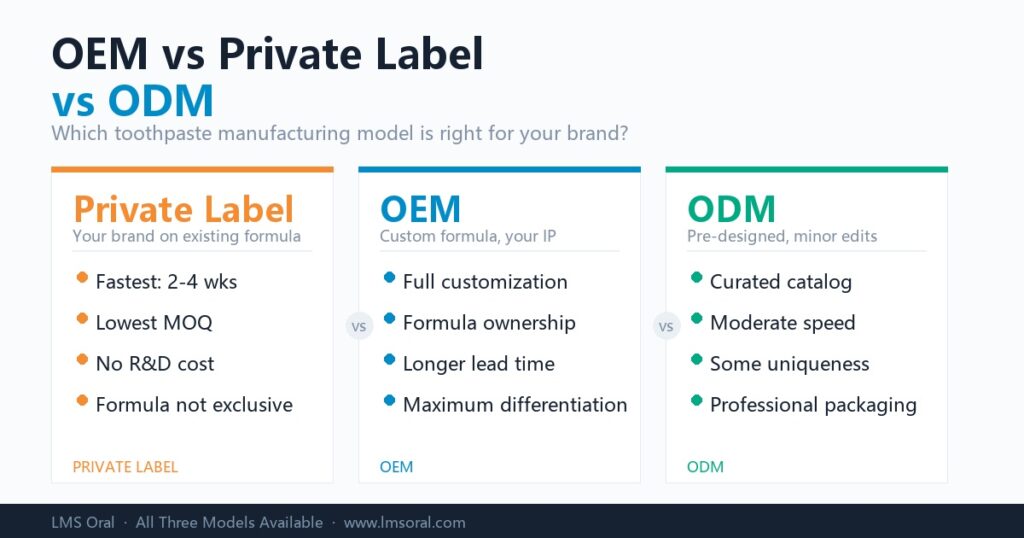
If you’re sourcing toothpaste for your brand, you’ve seen these three terms everywhere: OEM, Private Label, and ODM. Manufacturers throw them around, but the differences directly affect your costs, timelines, product uniqueness, and long-term business flexibility.
Here’s what each model actually means — and which one is right for your stage.
Quick Comparison
| Private Label | OEM | ODM | |
|---|---|---|---|
| Formula ownership | Manufacturer’s | Yours | Manufacturer’s |
| Customization level | Low (packaging only) | High (formula + packaging) | Medium (pick from catalog) |
| Time to market | 2–4 weeks | 8–16 weeks | 4–8 weeks |
| MOQ | Lowest (1,000–5,000) | Medium–High (5,000–50,000) | Low–Medium (3,000–10,000) |
| Unit cost | Lowest | Higher (R&D amortized) | Medium |
| Brand differentiation | Minimal | Maximum | Moderate |
| Regulatory ownership | Shared | Yours | Manufacturer’s |
| Best for | Market testing, fast launch | Established brands, unique positioning | Convenience, speed + some choice |
Private Label Toothpaste
What it is: You select an existing formula from the manufacturer’s catalog. They put your brand name, logo, and packaging design on it. The formula itself is not exclusive — other brands may sell the exact same product under different names.
How it works in practice:
- Manufacturer shows you 5–20 existing formulas (whitening, charcoal, kids, sensitive, herbal, etc.)
- You pick one, choose packaging specifications
- They produce with your branding
- Product ships in 2–4 weeks
Real example: A startup wants to launch a charcoal whitening toothpaste on Amazon. They choose a manufacturer’s proven charcoal formula, design an eye-catching box, and go to market in 3 weeks with a 3,000-unit first order.
Pros:
- Fastest route to market
- Lowest MOQ and upfront cost
- Zero R&D risk — the formula is already stable and tested
- Great for validating demand before committing to custom development
Cons:
- Your product is not unique — competitors can sell the same formula
- Limited ability to make ingredient claims
- Harder to build long-term brand equity
- Switching manufacturers means starting from scratch on formula
When to choose: You’re testing a new market, launching on a tight budget, or need speed over differentiation.
OEM (Original Equipment Manufacturer)
What it is: You work with the manufacturer’s R&D team to develop a custom formula from scratch — or significantly modify an existing one. You own the formula (usually under an NDA). The manufacturer produces it to your specifications with your branding.
How it works in practice:
- You define the target product profile: ingredients, claims, texture, flavor, target market
- Manufacturer’s chemists develop 3–5 prototype formulas
- You test samples, provide feedback, iterate (2–4 rounds typical)
- Final formula is locked, stability testing begins (3 months accelerated)
- Packaging design proceeds in parallel
- Production, QC, and shipment
Total timeline: 8–16 weeks from brief to shipment.
Real example: A dental clinic chain wants a professional-grade sensitivity toothpaste with nano-hydroxyapatite and a proprietary herbal blend. They work with the manufacturer’s R&D team through 4 formula iterations, finalize a unique formula, own it under NDA, and launch as their exclusive professional line.
Pros:
- Fully unique product — true competitive moat
- You control the ingredient story and marketing claims
- Higher perceived value and pricing power
- Formula exclusivity protected by contract
- Easier to defend against copycats on Amazon
Cons:
- Higher upfront investment (R&D fees: $500–$5,000 typical)
- Longer lead time
- Higher MOQ per SKU
- Requires more involvement from you during development
When to choose: You have an established brand (or serious funding), want a defensible product, and are playing the long game.
ODM (Original Design Manufacturer)
What it is: The manufacturer has pre-developed formulations and packaging designs. You choose from their design catalog — they’ve already done the R&D and packaging concept work. Think of it as “Private Label with presentation options.”
How it works in practice:
- Manufacturer presents a catalog of turnkey products: formula + suggested packaging design + claims
- You select a product, customize the brand name and minor design elements
- Product goes into production with minimal lead time
Real example: A beauty brand wants to add a toothpaste SKU to their existing line. They browse an ODM catalog, select a “Natural Whitening with Coconut Oil” toothpaste with a pre-designed minimalist box, add their logo, and order 5,000 units.
Pros:
- Faster than OEM, more unique than pure private label
- Professional packaging concepts included
- Moderate MOQ and cost
- Less decision fatigue — curated options
Cons:
- Formula not exclusive unless you negotiate
- Design shared with other brands using same ODM product
- Less control than true OEM
When to choose: You want some differentiation without the full R&D commitment of OEM.
Which Model Is Right For You?
| Your Situation | Recommended Model |
|---|---|
| First product, testing demand, tight budget | Private Label |
| Established brand, want unique formula, long-term play | OEM |
| Expanding product line, want speed + some choice | ODM |
| Amazon FBA, competing on price and volume | Private Label |
| Dental/medical channel, professional positioning | OEM |
| Adding oral care to existing beauty/wellness brand | ODM |
Common path: Many successful brands start with private label → validate the market → reinvest profits into OEM custom formulation → build true brand equity.
How LMS Oral Supports All Three Models
At LMS Oral, we offer full flexibility across all manufacturing models:
- Private Label: 15+ proven formulas ready for your branding, MOQ from 3,000 units
- ODM: Curated product + packaging catalog with room for customization
- OEM: In-house R&D lab with experienced formulation chemists, full NDA protection, formula ownership transferred to you
All models include: FDA/CE/ISO/Halal certification support, complete documentation package, and dedicated account management.
Contact us to discuss which model fits your brand — we’ll send you our Private Label catalog and OEM R&D process overview.
Interested in sourcing oral care products?
Contact us for a free consultation and quote.
Contact Us →