
How to Start Your Own Toothpaste Brand: Private Label Step-by-Step Guide
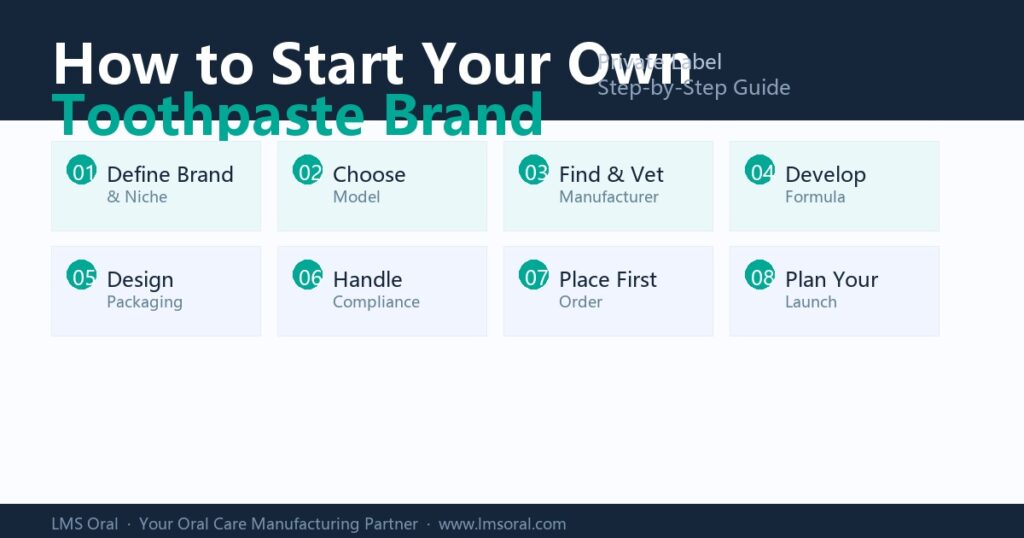
You’ve spotted a gap in the oral care market. Maybe it’s an underserved niche like probiotic toothpaste, a premium charcoal whitening line, or a kids’ toothpaste with better ingredients. Whatever your idea, launching a toothpaste brand is more accessible than most founders think — if you know the right steps.
Here’s the complete roadmap from concept to first shipment.
Step 1: Define Your Brand & Niche
Before contacting any manufacturer, get crystal clear on these five decisions:
• Target audience — Eco-conscious millennials, parents of young kids, luxury hotel chains, dental professionals
• Product positioning — Premium (+), mid-market (\u2013), budget/private label (\u2013)
• Key differentiator — Natural ingredients, fluoride-free, charcoal whitening, probiotic formula, custom flavor
• Geographic market — USA (FDA required), EU (CE + CPSR), Middle East (Halal), Southeast Asia
• Sales channel — Amazon FBA, Shopify DTC, wholesale to retailers, B2B dental distribution
Pro tip: The most successful new toothpaste brands don’t compete on “better mint flavor.” They own a specific niche: “hydroxyapatite toothpaste for sensitive teeth,” “kids toothpaste with zero artificial sweeteners,” or “plastic-free toothpaste tablets.”
Step 2: Choose Your Manufacturing Model
Three paths, each with different trade-offs:
• Private Label — Use the manufacturer’s existing formula, put your brand on it. Best for: Fast launch, lower cost, testing the market.
• OEM (Original Equipment Manufacturer) — Custom formula developed for you, your brand on it. Best for: Unique product, competitive differentiation.
• ODM (Original Design Manufacturer) — Manufacturer designs formula + packaging, you pick from their catalog. Best for: Hands-off approach, smaller brands.
Most startups begin with private label to validate demand, then transition to OEM for a proprietary formula once they have traction.
Step 3: Find and Vet a Toothpaste Manufacturer
This is the step that makes or breaks your brand. Key criteria:
• Certifications: FDA registration (for US), CE marking (for EU), ISO 22716 GMP, Halal if needed
• MOQ flexibility: Can they start at 5,000–10,000 units for your first order?
• In-house R&D: Do they have chemists who can customize your formula?
• Communication: Do they respond in clear English within 24 hours?
• Sampling: Will they send pre-production samples for your approval?
Request at least 3 quotes and compare not just price, but the full package: formulation support, design assistance, documentation (SDS, COA, stability tests), and shipping terms.
Step 4: Develop Your Formula
Work with the manufacturer’s R&D team on:
• Active ingredients: Fluoride vs. nano-hydroxyapatite vs. natural alternatives
• Flavor profile: Mint, herbal, fruit, or custom blend
• Texture: Smooth paste, gel, or dual-color stripe
• Special claims: Whitening, sensitivity relief, enamel repair, gum health
• Free-from claims: Fluoride-free, SLS-free, paraben-free, vegan
Request lab samples at every iteration. Don’t approve bulk production until you’ve personally tested the final sample.
Step 5: Design Your Packaging
Your tube and box are your shelf presence. Key decisions:
• Tube material: Laminate (standard), aluminum-barrier (premium), PCR recycled (eco)
• Tube size: Travel (15g–25g), standard (75g–120g), family (150g–200g)
• Box design: Color scheme, logo placement, ingredient panel, barcode
• Compliance text: FDA Drug Facts panel (US), ingredient list per INCI, warnings
Many manufacturers offer in-house design support or will work with your designer’s files. Ensure your artwork includes all mandatory regulatory information for your target market.
Step 6: Handle Compliance & Documentation
This step catches many first-time brand owners off guard. Depending on your market:
• USA (FDA) — FDA Drug Establishment Registration, Drug Listing, compliant Drug Facts labeling
• EU — Cosmetic Product Safety Report (CPSR), Product Information File (PIF), Responsible Person
• Middle East — Halal certification, GSO compliance
• Australia — TGA listing (if therapeutic claims)
A good manufacturer will provide supporting documents: SDS, COA, FSC, microbiological test reports, stability test results. Keep these organized — you’ll need them for customs clearance and retailer onboarding.
Step 7: Place Your First Order
Final checklist before signing the PO:
☐ Approved final sample in hand
☐ Packaging artwork signed off
☐ All certifications verified (check issuing body websites directly)
☐ Payment terms agreed (typically 30% deposit, 70% before shipment)
☐ Shipping terms clear: FOB, CIF, or DDP?
☐ Inspection rights: can you arrange third-party inspection before shipment?
☐ Lead time confirmed in writing
Step 8: Plan Your Launch
While production is underway:
• Amazon listing: Professional photos, A+ Content, keyword-optimized title and bullets
• Website: Shopify store with brand story, product page, and blog
• Social proof: Send samples to influencers and early adopters for reviews
• Content marketing: Blog posts targeting buyer keywords in your niche
• Inventory: Order enough to cover 3–4 months of projected sales
Ready to Start Your Brand?
At LMS Oral, we’ve helped brands across 30+ countries go from concept to shelf. Our 50,000 sqm FDA-registered facility offers:
• Private label and full OEM custom formulation
• Low MOQ for new brands (starting from 5,000 units)
• In-house R&D lab with experienced chemists
• Complete documentation package for FDA, CE, and Halal compliance
• Design support for packaging and branding
Contact us to discuss your toothpaste brand vision. We’ll send you a free formulation consultation and sample request form.
Interested in sourcing oral care products?
Contact us for a free consultation and quote.
Contact Us →