Toothbrush Bristle Types Compared: Nylon-6, Nylon-610, PBT and Charcoal
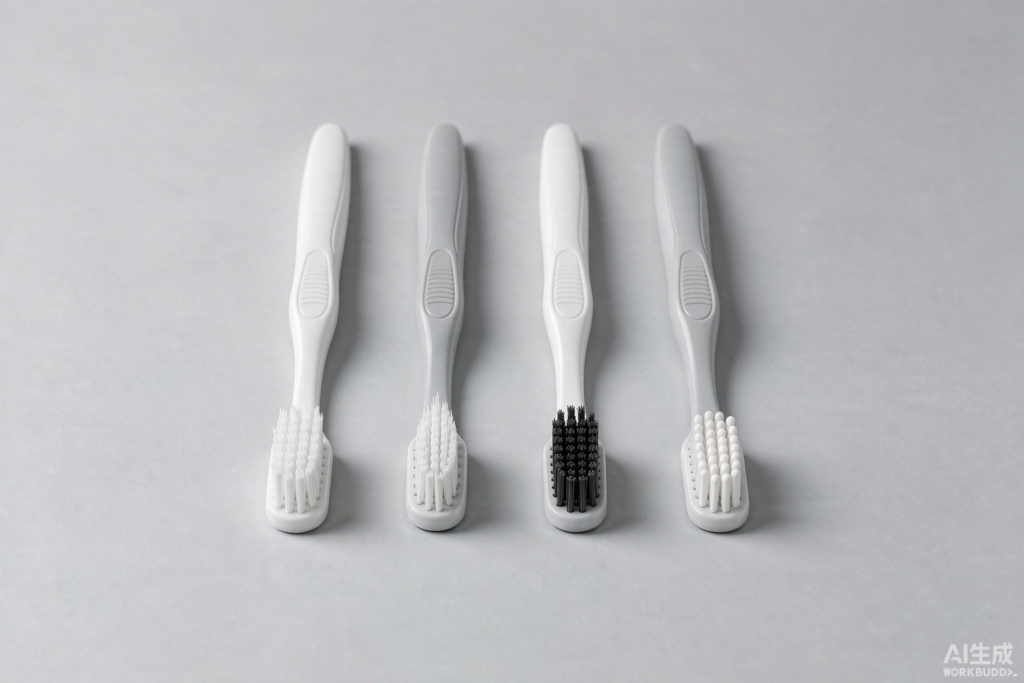
Why Bristle Specification Is a Buying Decision
Most buyers pick a toothbrush by handle colour and packaging, then accept whatever filament the factory proposes. That is backwards. The filament decides the feel, how the brush survives a wet carton on a long voyage, what you can claim on the retail pack, and what the unit costs at volume.
The Four Filament Families Buyers Actually Quote
- Nylon-6 (PA6) — the volume default: soft, consistent, cheapest to source, runs on standard tufting lines. It takes up more water than the alternatives, so it dries slower and can lose stiffness in humid storage.
- Nylon-610 and nylon-612 — the upgrade tier. Lower moisture uptake keeps the brush in shape through wet packing and repeated use, and the filament recovers better after compression. Higher material cost, fewer lines run it as standard.
- PBT (polybutylene terephthalate) — the choice for tapered and ultra-fine tips. It holds a fine taper and resists moisture, which is why it anchors most “soft” and “extra soft” positioning. It is the costliest of the three synthetics and needs a factory experienced in fine-tip tufting.
- Charcoal-infused filaments — nylon or PBT loaded with charcoal powder. The value is visual differentiation and shelf storytelling, not measurable cleaning performance. Ask what the base polymer is; “charcoal” alone is a colour, not a material spec.
Side-by-Side Comparison
| Filament | Feel | Moisture behaviour | Cost direction | Typical positioning |
|---|---|---|---|---|
| Nylon-6 | Soft to medium | Higher uptake, slower drying | Lowest | Value and volume SKUs |
| Nylon-610/612 | Soft, resilient | Lower uptake, holds shape | Medium | Mid-tier, hotel, subscription |
| PBT | Very soft, fine tip | Low uptake, fast recovery | Highest | Premium, sensitive-gum lines |
| Charcoal-infused | Varies with base | Varies with base | Base cost plus additive | Differentiated retail and gifting |
Treat cost as direction only: filament price moves with polymer grade, taper, tufting density and your order volume.
What to Lock on the Spec Sheet
- Base polymer in writing — nylon-6, nylon-610/612 or PBT. Never “soft bristles”.
- Filament diameter — the figure that actually defines soft, medium and hard. Have the factory quote it and attach it to the golden sample.
- Tip treatment — rounded, tapered or ultra-fine. This drives feel and claim language.
- Tufting density and pattern — more tufts means more filament and a different unit cost.
- Colour source — for charcoal and other dark filaments, confirm the additive is compounded into the filament rather than surface-coated.
- Sample retention — keep an approved golden sample per SKU so reorders can be checked against something physical.
Where Buyers Lose Money
The common failure is specifying “soft” and receiving three different brushes across three reorders, because softness was never quantified. The second is paying PBT pricing for a nylon-6 brush: without a polymer declaration on the spec sheet and the contract, there is nothing to inspect against. The third is a charcoal claim a retail compliance team rejects — check your market’s rules on whitening and antibacterial language before artwork goes to print.
For what each spec line does to your quotation, see our toothbrush unit cost breakdown. Still choosing between building a spec and buying an existing one? Start with OEM vs ODM vs private label.
Frequently Asked Questions
Which toothbrush bristle type is cheapest at volume?
Nylon-6, because it is standard on most tufting lines and needs no special tooling. The saving shrinks once you add tapering, high tuft density or custom colour, so compare quotes on the full spec.
Is PBT worth the premium for a private label range?
Yes if your positioning rests on softness or sensitive-gum claims, because PBT holds a fine taper that nylon does not. For value SKUs the difference is rarely visible to the end buyer and the extra cost is hard to defend.
Do charcoal bristles require different documentation?
The filament itself usually does not, but the claims around it often do. If your pack claims whitening, antibacterial or detox benefits, your market may require substantiation. Confirm with your own compliance adviser before print.
Can I mix filament types in one order?
Per SKU, yes. Multi-SKU runs are normal; ask whether line changeover adds cost or lead time, and give each SKU its own approved sample.
Next Step
Brief the filament alongside the handle — start with custom OEM development. If speed matters more, browse ready-to-ship stock and brand it now. For low-volume first orders, see what a low MOQ toothbrush supplier can commit to, and read the private label toothbrush procurement guide for the route from drawing to delivery.
Send your target filament, quantity and destination market to sales@lmsoral.com, or message us on WhatsApp at +86 17703320885. We will quote the filament options side by side and flag any claim or compliance risk before you place a deposit.
Interested in sourcing oral care products?
Contact us for a free consultation and quote.
Contact Us →