Pre-Shipment Inspection Failed? The Oral Care Importer’s Playbook for Rejected Goods, Rework, and Claims
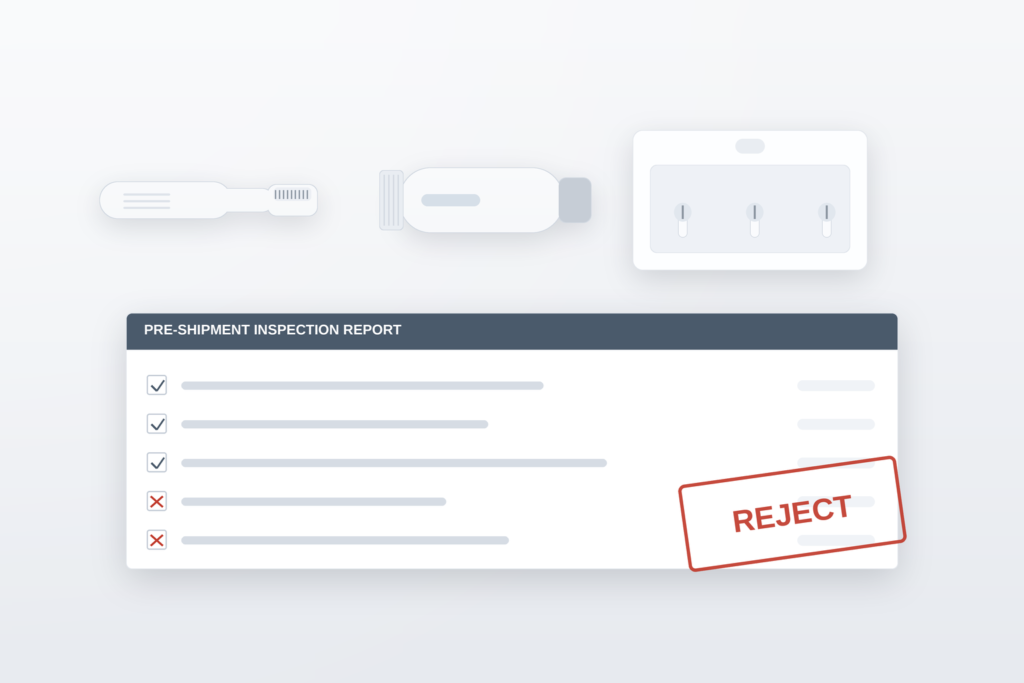
A failed pre-shipment inspection is one of those calls every oral care importer remembers. The container is booked, the PO is paid or nearly paid, your retail launch date is fixed — and the inspection report lands with a red result. What you do in the next 48 hours determines whether this becomes a managed quality event or an expensive dispute that burns both your margin and your supplier relationship.
This playbook walks through the decisions that matter: what “failed” actually means, how to respond in the first two days, how to choose between sorting, rework, discount, and rejection, and how to convert a failed inspection into a claim the factory actually pays. It is written for importers, brand owners, Amazon/FBA sellers, and distributors buying private-label or OEM oral care from Asia.
When a Pre-Shipment Inspection Actually “Fails”
A pre-shipment inspection (PSI) is not an opinion — it is a statistical verdict against the sampling plan and specification you agreed in the purchase order. The inspector pulls a random sample from finished, packed goods and classifies every defect as critical, major, or minor. If the number of defects in any class exceeds the acceptance number for your chosen AQL level, the lot fails. If you need a refresher on how those levels are set, our guide to oral care QC inspection and AQL levels breaks it down.
In oral care specifically, the failures we see most often are predictable:
- Toothbrushes — bristle tuft pull-out, filament splaying, handle flash or sink marks, wrong pad print color or position
- Toothpaste — tube seal leaks or crimp wrinkles, under/over fill weight, viscosity or flavor drift versus the golden sample, missing batch code
- Flossers and interdental brushes — floss tearing, weak handle welds, incorrect coating
- Kit and set assembly — wrong SKU mix in the carton, missing inserts or leaflets, artwork version errors
- Transit readiness — carton drop-test failures, pallet pattern collapsing, carton markings that do not match the packing list
Note that several of these are documentation and packaging failures, not product failures. A missing batch code or an outdated artwork file can fail an inspection just as hard as a leaking tube — and both create compliance risk at your border, not just cosmetic risk on shelf.
The First 48 Hours: Freeze, Verify, Document
The biggest mistake buyers make is reacting before the facts are pinned down. Run this sequence instead:
- Freeze the lot. Instruct the factory in writing that nothing ships, nothing is reworked, and nothing is re-packed until you say so. Verbal approvals get “remembered” differently three weeks later.
- Collect the evidence pack. Inspection report with defect classification, photos or video of each defect type, sample count versus lot size, and the exact AQL plan used. If the report does not state these, ask — a vague report is itself a red flag.
- Verify before you escalate. For a borderline result, commission a re-check — either a second PSI at a different time of day, or an independent third-party inspection. Suppliers occasionally dispute sampling luck; a documented re-check settles that argument cheaply.
- Check your claim window. Your contract or PI should state how quickly quality claims must be raised after inspection (commonly a short, fixed window). Miss it and your leverage collapses even when the defects are obvious.
- Notify in writing, through one channel. One email to your factory contact, copied to their sales manager, stating: lot failed, defect classes, your intent to inspect the root cause, and that all costs of containment are claimable pending root cause.
- Do not authorize rework on the phone. Rework changes the goods — sometimes for the worse. It needs a written method, a re-inspection, and an agreed cost owner first. (See the decision framework below.)
Sort, Rework, Discount, or Reject? A Decision Framework
Once the failure is verified, you have five realistic options. The right one depends on defect severity, your deadline, and the cost math.
| Option | Best when | Who typically pays | Watch-outs |
|---|---|---|---|
| 100% on-site sorting | Defects are visual and detectable (color, flash, print) | Factory, if defect is confirmed production-side | Agree the defect criteria in photos first; require a re-inspection after sorting |
| Rework / repair | Fixable without touching safety or function (re-print, re-pack, re-code) | Factory | Reworked goods must be treated as a new lot and re-inspected; some rework (e.g., re-sealing tubes) is not acceptable |
| Discount and ship as-is | Minor defects only, within your market’s tolerance | You absorb, factory credits | Get the discount in writing before shipment; confirm the defects will not trigger retailer chargebacks |
| Partial accept | One SKU or one production date failed, others clean | Factory pays re-inspection of the split | Make sure the failed portion is clearly segregated and documented |
| Reject and remake | Critical defects, safety issues, or systemic process failure | Factory | You will likely miss your ship date — model the delay cost before choosing this path |
Two rules cut across every option. First, critical defects are not negotiable — anything with a safety, regulatory, or contamination implication means stop, regardless of your launch date. Second, never let a deadline pressure you into accepting goods you would not defend to your own customer. A failed container is a bad week; a recall or a marketplace suspension is a bad year. Importers who sell into retail or regulated channels should also be clear on their own exposure — our overview of product liability insurance for oral care importers covers how this risk is transferred.
Who Pays? Turning an AQL Failure into a Costed Claim
A failed inspection generates real, itemizable costs: the inspection fee, sorting labor, rework materials, re-inspection, re-booked freight, and — if the launch slips — penalty clauses or lost promotional windows. Whether you recover them depends almost entirely on paperwork that should already exist:
- The specification and golden sample. If the PO references a sealed golden sample and PP sample, defect disputes end quickly: the goods either match the reference or they do not. If your order never had a golden sample, this is the lesson to learn.
- The contract’s quality and claim clauses. Your OEM/ODM agreement should state the AQL plan, the claim window, and that confirmed production defects make the factory liable for containment, rework, and re-shipment costs.
- Payment terms as leverage. This is where buyers on conservative payment terms have a structural advantage: if the balance is unpaid at PSI time, the corrective work happens before money moves. If you have already paid 100% upfront, your only leverage is the relationship and the claim clause.
- The delivery term. Under FOB, quality failures found pre-shipment are cleanly the factory’s problem. Under DDP or other door-to-door terms, failures discovered later get murkier — another reason the PSI is your last clean checkpoint before goods leave the factory’s control.
Quantify the claim in the same currency and incoterms as the PO, attach the evidence pack, and give the factory a dated response deadline. A claim without numbers is a complaint; a claim with numbers is a negotiation.
Writing a SCAR the Factory Will Actually Act On
For systemic failures — not one-off defects — send a formal Supplier Corrective Action Request (SCAR). Good SCARs borrow the 8D structure quality engineers already know, which means the factory’s own QC team can execute it without translation:
- Containment — what has been done today to stop defective goods moving (sorting, quarantine, line stop).
- Root cause — five-why analysis with evidence, not “worker carelessness.” A tuft-pull failure traces to filament diameter, anchor depth, or glue parameters; make the supplier go that deep.
- Corrective action — what changes on this lot.
- Preventive action — what changes in the process so this cannot recur (SPC on fill weights, first-article checks after changeovers, artwork version control).
- Verification — you re-inspect the next lot; the SCAR only closes on evidence, not on a written apology.
Log the outcome in your supplier scorecard. One failed lot with a fast, well-executed SCAR is often a better long-term supplier than one that never failed but never shows you their process either. Two failed lots with the same root cause is a sourcing decision, not a quality event.
When the Root Cause Is Upstream
Sometimes the inspection failure is a symptom of something earlier in the chain: a material substitution the buyer never approved, an uncalibrated filling line, or a second-shift workforce that never saw the golden sample. If the SCAR’s root cause points upstream, widen the response:
- Re-audit the factory against your supplier audit checklist — focus on incoming material control and change management, not just the final line.
- Re-pin the specification: batch codes, shelf-life marking, and artwork versions should be traceable lot by lot (see shelf-life, PAO and batch coding).
- Freeze engineering changes in writing — a common failure mode is a “small improvement” to a mold or formula that was never approved by the buyer.
And if you are pre-qualification stage rather than mid-crisis, note that prevention is dramatically cheaper than recovery: every dollar of inspection and specification discipline avoids multiples of it in claim season.
FAQ
Can I accept the shipment now and file a claim later?
Technically sometimes, strategically almost never. Once goods leave the factory under FOB, proving that defects existed pre-shipment becomes your burden, and many claim windows expire on shipment or a few days after arrival. If you must ship (retail deadline), get a written defect acknowledgment and a pre-agreed credit from the factory before the container is loaded.
Should I pay for a third-party re-inspection?
Yes when the stakes justify it: a disputed result, a high-value lot, or a first order with a new supplier. Who pays depends on your contract — if the re-inspection confirms the original failure, the cost is claimable alongside the other containment costs. Buyers who skip the re-check to save a small fee often spend far more arguing about defect counts afterward.
What if the supplier blames my artwork files or packaging design?
This is why version control matters. If the PO references specific, dated artwork files and an approved golden sample, the supplier accepted those inputs when they signed. Genuine artwork-induced failures (e.g., your dieline mismatches their machine spec) should have been caught at pre-production approval — which is precisely what the PP sample stage exists to verify.
Does a failed inspection change my compliance obligations as importer?
No — your obligations as importer of record (product safety, labeling, market-specific requirements) apply regardless of what the factory did or did not get right. What changes is your evidence trail: a documented failed inspection, a SCAR, and a re-inspection report show a functioning quality system if a regulator, retailer, or marketplace ever asks. For anything touching customs treatment or restricted ingredients, confirm specifics with your customs broker rather than relying on general guidance.
Get a Second Pair of Eyes Before the Container Leaves
Most failed inspections are preventable months earlier — at specification, at golden-sample approval, and at the mid-production checkpoint nobody booked. If you would rather not run this playbook from experience, our OEM & private-label service embeds specification control and on-site QC into the sourcing process itself, and our ready-to-ship program offers pre-qualified oral care SKUs when a remake simply will not make your launch date.
Talk to the LMS Oral supply chain team:
- Email: sales@lmsoral.com
- WhatsApp: +86 177 0332 0885
Bring us the failed inspection report — we will tell you honestly whether the lot is salvageable, and what it should cost to fix.
Interested in sourcing oral care products?
Contact us for a free consultation and quote.
Contact Us →