First-PO Budget for Oral Care Brands: The One-Time Costs Buyers Miss
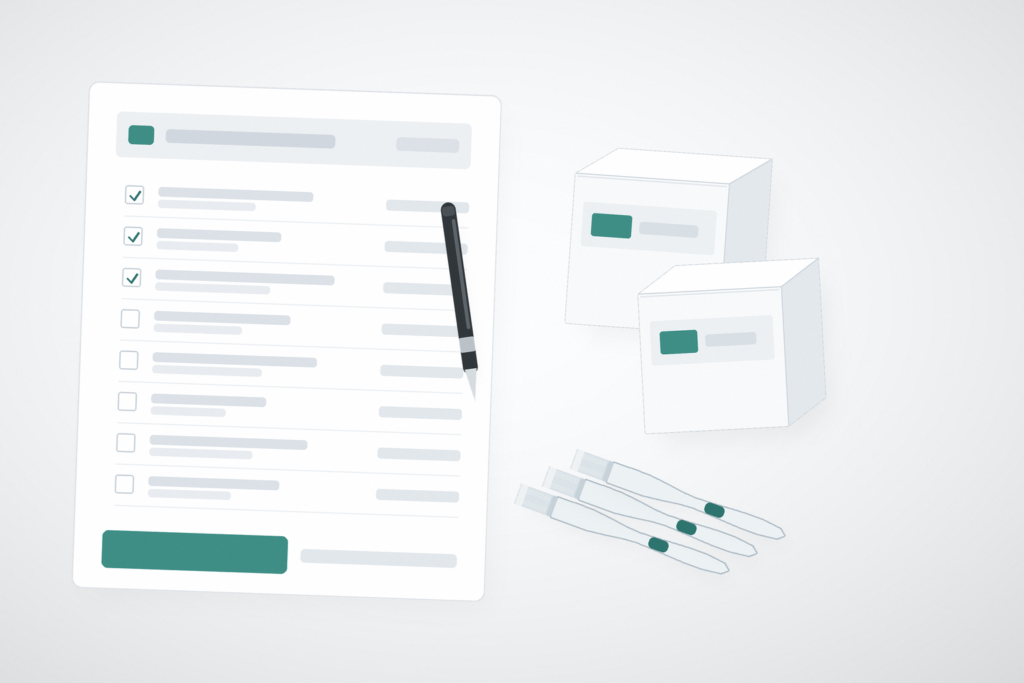
Unit Price Is Not Your First-PO Budget
Most first-time buyers budget the same way: unit price times quantity, plus freight. That number survives until the second email from the factory, which mentions tooling, printing plates, artwork and a test report. None of that is padding — it just is not inside a unit-price quote, and it generally falls due before you own anything sellable.
For importers, brand owners, Amazon/FBA sellers and distributors, the fix is to run two budgets. Unit cost and freight are the recurring half, already covered in our landed cost breakdown and toothbrush unit cost stack. What follows is the other half: one-time development costs your first PO carries and reorders do not.
One-Time vs Every-Shipment Costs
| Cost line | When it hits | Frequency | How it is usually quoted |
|---|---|---|---|
| Tooling or mould | Before first production | Once per tool set | Lump sum, or amortised into unit price |
| Printing plates and cylinders | Before packaging runs | Once per artwork version | Per colour, per plate |
| Artwork and dieline adaptation | Design stage | Once per SKU | Per-SKU design fee |
| Samples and courier | Before approval | Once per approval round | Per sample set plus freight |
| Line trial and first-run scrap | Start of production | Once | Factory-borne or shared — agree first |
| Compliance testing and reports | Before first shipment | Per destination market | Per requested test report |
The distinction is commercial, not just accounting. A tooling charge recovered over one small order looks unbearable; over a year of reorders it barely moves unit cost. That is why factories offer to fold tooling into unit price — and why you should always ask what that unit price becomes once the tool is paid for.
Why Timing Hurts More Than Size
These costs cluster in the deposit window: tooling, plates and testing all fall due while nothing exists yet, so cash is committed months before revenue — see payment terms and import cash-flow planning. Fund a first PO to peak, not to average.
There is a knock-on effect. One-time costs eat units you meant to buy, dropping you below the volume the unit quote assumed. Before trimming quantity, re-read MOQ vs MPQ vs SPQ — consolidating variants usually protects units per SKU better than cutting everything evenly.
What to Put on Paper Before You Sign
- Written breakdown separating one-time tooling and development charges from unit price, line by line.
- Whether each tool set already exists. Stock tooling means no tooling charge at all — ask before assuming.
- If tooling is amortised into unit price, what that unit price becomes once amortisation is recovered.
- Revision policy: free artwork revisions, and cost per additional plate or cylinder.
- Sample policy: whether golden and PP samples are credited against the order or billed regardless, and who pays courier. See golden sample vs PP sample for what those approvals lock.
- Which compliance reports are included and which are billed extra, per market. Confirm requirements with your broker or notified body rather than assuming.
- Tooling ownership and removal rights, set out in OEM contract, IP and tooling clauses.
- Contingency for one extra artwork revision and one re-test — the two most common first-order overruns.
FAQ
Are tooling fees refundable if I cancel?
Usually not once steel is cut; the mould is a physical asset built to your specification. Negotiate a milestone instead: tooling invoiced after you approve the golden sample rather than before design freeze.
Is it better to pay tooling upfront or amortise it into unit price?
Upfront keeps unit cost transparent and your options portable. Amortised pricing lowers the entry cheque but hides the tool cost and can lock you in until recovery volume is met. Decide on expected reorder behaviour, not headline price.
Do these costs disappear with stock products?
Most do. Existing tooling, artwork and test reports leave little to develop. That is why testing demand through ready-to-ship stock beats commissioning a custom tool set on day one.
Why did two quotes differ so much for the same brush?
Because one included development charges and the other assumed stock tooling, different plating or a narrower approval scope. Compare total one-time cost plus landed cost per sellable unit, never unit price alone.
Budget the First Order in Two Columns
Send us your product idea, target market and expected reorder volume: we will quote the full first-PO picture — one-time development charges and per-shipment unit cost in two separate columns — so you can see what you are funding and when. Start an OEM project or test the market first with ready-to-ship stock.
Email sales@lmsoral.com or message us on WhatsApp at +86 17703320885.
Interested in sourcing oral care products?
Contact us for a free consultation and quote.
Contact Us →