Chinese New Year Factory Shutdown: Planning Your 2027 Oral Care Production Calendar
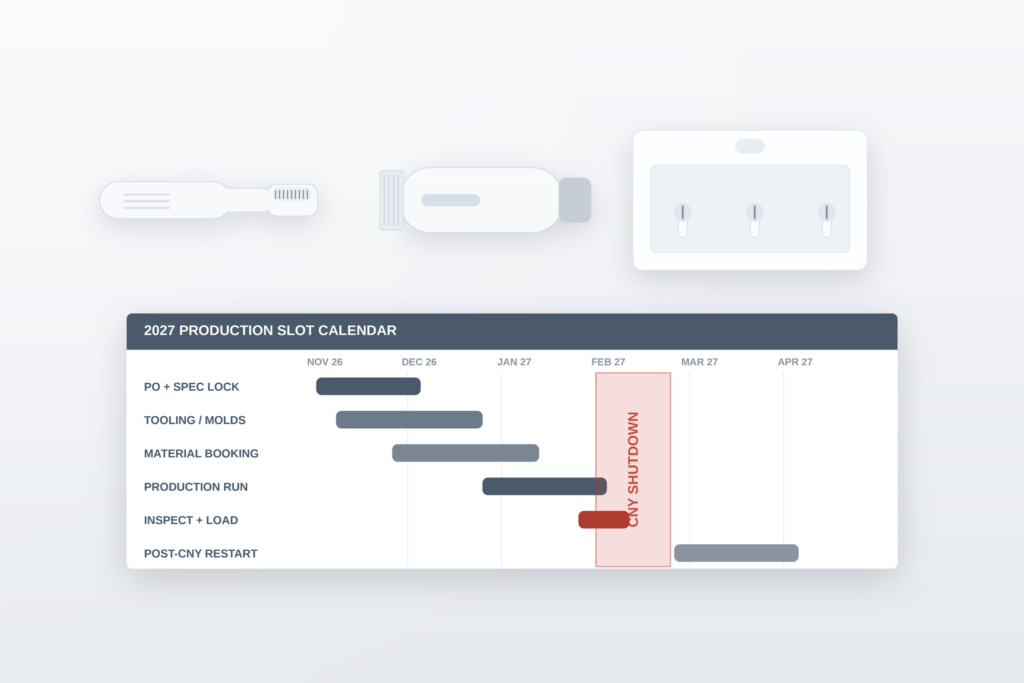
Every year, otherwise well-run oral care brands get ambushed by the same predictable event: the Chinese New Year factory shutdown. Orders that “should have shipped in January” leave in March. New tooling that was quoted with a six-week lead time quietly becomes a ten-week lead time because the mold shop closed for the holiday too. And buyers who assumed the disruption lasts “about two weeks” discover that the real blackout window — factory plus upstream component suppliers plus freight — is closer to six.
The good news is that this is the single most forecastable disruption in the sourcing calendar. As of late October 2026, you have a clean runway to lock in production that ships before the lines close. This guide gives you the 2027 shutdown window, a countdown calendar working back from it, and the four things that must be locked before the last line stops.
Why the Shutdown Breaks Supply Chains That “Planned”
Importers who get burned by Chinese New Year usually planned around the wrong number. The holiday itself is about a week of official public holidays, but the operational disruption is far wider, for three reasons:
- Worker migration. Most factory workers travel long distances home for the holiday, and a meaningful share do not return immediately — many come back after the Lantern Festival or only after switching factories. Output in the weeks after restart is reliably below normal.
- The whole supply chain closes, not just your factory. Your toothbrush molder may promise to hold a skeleton crew, but their filament supplier, tube converter, carton printer, and the mold shop cutting your new tooling all close on their own schedules — often earlier and for longer.
- Capacity compression on both sides. Every buyer tries to ship before the closure and every buyer whose goods missed the boat needs production immediately after restart. Slots in January and in March are both scarce, and that scarcity shows up in lead times, in freight, and occasionally in price.
In other words: the holiday is a week; the planning problem is roughly November through March. Our breakdown of what actually happens between PO and vessel explains why the calendar math is tighter than most buyers assume.
The 2027 Shutdown Window: What Buyers Should Plan Around
Chinese New Year 2027 falls on Saturday, 6 February 2027 (Year of the Goat). The official public holiday is expected to run for roughly a week from that date, but treat the calendar date as the center of the risk, not its boundary. In practice:
| Phase | Typical timing | What it means for your order |
|---|---|---|
| Pre-CNY rush | Early January – early February | Production slots and vessel space are tight; quality oversight matters most |
| Line wind-down | Last 1–2 weeks before 6 February | Factories finish WIP, stop accepting new rush orders, start maintenance |
| Official holiday | Around 6–12 February 2027 | Offices and lines closed; confirm exact dates with your supplier in writing |
| Extended closure | Mid – late February | Many factories and most upstream component suppliers restart gradually |
| Ramp-up | Late February – March | Output below capacity; new orders queue behind carryover backlog |
Two cautions. First, the official holiday schedule is announced by the authorities and individual factories add their own days on either side — get your factory’s specific shutdown and restart dates in writing, and get the same from critical component suppliers. Second, never let a supplier’s reassurance that “we can ship before the holiday” go unverified: ask which week production is slotted, not just whether it is possible.
Counting Backwards: Your Pre-Shutdown Countdown Calendar
Working back from the early-February 2027 closure, here is the schedule we recommend for orders that must ship before the shutdown. If you are reading this in October or November 2026, you are on schedule — but barely, if tooling is involved.
| Deadline | Milestone | Why it can’t slip |
|---|---|---|
| Early November 2026 | POs finalized, spec sheets and artwork frozen | Everything downstream queues behind an unambiguous spec |
| Mid November 2026 | Golden sample / PP sample approved | No line should start without an approved reference (see the golden sample vs PP sample workflow) |
| Late November 2026 | New tooling and molds kicked off | Mold work is the longest pole; it also needs sampling and approval cycles |
| December 2026 | Raw materials and components booked, deposits paid | Resin, filament, tube stock and cartons are reserved early; suppliers cut off new bookings before the holiday |
| Early–mid January 2027 | Production slotted and started | January slots are allocated first to buyers who confirmed earliest |
| Mid–late January 2027 | AQL-based pre-shipment inspection and container loading | The last clean checkpoint before goods leave the factory’s control |
| Early February 2027 | Vessel departure | Book freight weeks ahead — space tightens sharply pre-CNY |
| Late February – March 2027 | Restart, backlog clearing, Q2 re-orders | Post-CNY capacity goes to whoever re-confirmed first |
If your timeline cannot hit these marks, don’t force it — a realistic plan beats a hopeful one. That is exactly when the decision framework in our FCL vs LCL comparison and the fallback of pre-qualified ready-to-ship stock (below) start to matter.
The Four Things That Must Be Locked Before the Line Stops
Across categories, the orders that survive the shutdown intact are the ones where four inputs were nailed down early.
1. Tooling and molds. A new private-label toothbrush or flosser means new tooling, and mold shops are among the first to close and the last to reopen. If your mold is not cut, sampled, and approved before the holiday, first mass production realistically lands after restart — which is why tooling sign-off belongs in November, not December. Make sure your contract is explicit about who owns the tooling and IP before a shutdown separates you from your molds for six weeks.
2. Materials and components. Suppliers reserve capacity for confirmed orders with deposits. An unconfirmed material list in December becomes a February scramble, because your factory’s own suppliers — film, foil, filament, bristle, carton board — close earlier than the assembly plant. Confirm quantities, and confirm in writing that materials are physically in the factory’s warehouse before the holiday.
3. Artwork, packaging, and compliance documents. A printed-carton error discovered in late January cannot be fixed by reprinting — the printer has already shut down. Freeze artwork versions, confirm dielines against the private label packaging artwork checklist, and make sure your document set (COA, test reports, labeling files) is complete before production starts. If this is a first shipment into a new market, classification and paperwork should be settled with your broker well before loading — our overview of HS codes and customs classification covers where to start, and for anything duty-specific, verify with your customs broker rather than relying on general guidance.
4. Deposit and slot confirmation. Production slots pre-CNY are allocated by suppliers to their most committed buyers first. A confirmed PO with a paid deposit and a written production week is a slot; a “we’ll try to fit you in” is not. Your payment terms are leverage here — buyers with staged payments tied to inspection results get priority attention without giving up protection.
The Pre-CNY Quality Dip — and How to Defend Against It
Here is the uncomfortable pattern quality inspectors see every January: the orders most likely to fail inspection are the ones rushing to ship before the holiday. Overtime shifts, new temporary workers, and the pressure to finish WIP combine into exactly the conditions that produce defects — bristle pull-out, weak heat seals, fill-weight drift, mis-assembled kits.
Do not cancel your inspection to make a departure date. Instead:
- Schedule a during-production check in early January, not just a final inspection — catching a process problem when 30% is made is cheap; catching it at 100% is a shutdown-week crisis.
- Hold the line on your agreed AQL levels, and make the defect classification explicit in the PO (our guide to QC inspection and AQL levels shows how).
- Verify against the approved golden sample, not against photos on WeChat.
- If a borderline lot fails in the last week of January, revisit your options honestly — sorting, discount, or shipping after the holiday — rather than accepting goods you would not defend to your own retail customer.
A container that leaves late but clean is an inconvenience. A container that leaves on time with systemic defects is a year of chargebacks, returns, and listing suspensions.
Freight, Cash, and Inventory Around the Closure
Three commercial issues compound the production problem:
- Vessel space and rates. Carriers see a pre-CNY cargo surge; space on key routes tightens and premiums appear. Confirm bookings two to three weeks earlier than you would in a normal month, and decide early whether FCL economics or LCL flexibility fits this order.
- Inventory coverage. Your pipeline will effectively be dark for six to eight weeks — from last pre-CNY departure until post-restart goods arrive. Map that gap against your sales forecast and your FBA reorder lead times; our guide to inventory and cash-flow planning walks through sizing the buffer without over-ordering.
- Cash timing. Deposits for material booking land in November–December, balances often fall due around shipment in January, and post-CNY re-orders follow fast. Stage your budget accordingly — the one-time cost items are covered in our first-PO budget model.
Should You Rush to Ship Before CNY or Wait Until After?
A simple rule of thumb:
- Ship before the shutdown when the goods are stable, inspected, and fully packed — and when your sales forecast genuinely needs them in February–March. Never compress inspection to hit the boat.
- Wait until after restart when tooling is new, the spec is unproven, or the product is not needed on shelf until late spring. A first production run deserves full sampling and inspection discipline; the calendar should not decide your quality posture.
- Split the order when part of the demand is urgent: ship proven, running SKUs pre-CNY and move new or revised SKUs to the post-CNY queue deliberately.
Your Pre-Shutdown Checklist
Use this list as your November gate review:
- PO signed with frozen spec sheets, artwork versions, and packaging dielines
- Golden sample approved and sealed; PP sample sign-off documented
- Tooling kicked off (new molds) or confirmed available (running SKUs)
- Material and component booking confirmed with deposit; materials in the factory’s warehouse
- Production week confirmed in writing; deposit paid against agreed payment terms
- During-production inspection scheduled for early January
- AQL plan and defect classification stated in the PO
- PSI booked for mid-to-late January, with a named inspector and a dated report commitment
- Freight booked; loading date aligned with the PSI pass
- Post-CNY re-order intent communicated to the supplier so you are first in the restart queue
FAQ
How long are oral care factories actually closed for Chinese New Year?
The official holiday is about a week, but plan for a six-to-eight-week operational disruption: wind-down in late January, closure around 6 February 2027, gradual restart through late February, and below-normal output into March. Component suppliers often close earlier than assembly plants and reopen later. Get each supplier’s specific dates in writing — they differ every year and every factory.
When should I place an order to ship before the 2027 shutdown?
For running SKUs with existing tooling: PO confirmed by early-to-mid November 2026, materials booked in December, production in early-to-mid January, inspection and loading by late January. For new tooling or a new factory relationship, add sampling and mold time — realistically you needed to start in September or October, and the honest answer may be a post-CNY delivery.
Do prices go up before Chinese New Year?
They can — but not because of the holiday itself. What moves is the cost of scarcity: January production slots, pre-CNY vessel space, and any materials that suppliers must source at short notice because booking windows were missed. Buyers who lock POs, materials, and freight early generally pay quoted prices; buyers who scramble in January pay whatever the market asks. Labor-driven price adjustments, where they occur, are negotiated separately and should be documented through your normal quotation process.
Is it risky to start a new mold right before the shutdown?
It is risky to expect a new mold to be finished and mass-produced before the shutdown. Mold cutting, T1 samples, revisions, and sample approval rarely fit cleanly into the weeks that remain once you account for the mold shop’s own holiday schedule. Plan new-tooling projects for first production after restart, and use the pre-CNY window for mold fabrication, T1 sampling, and golden-sample approval so that production can start the week the factory reopens.
Plan the Shutdown Once, Not Every January
The importers who never get burned by Chinese New Year are not luckier — they run the same countdown every autumn: specs frozen, tooling kicked off, materials booked, slots confirmed, inspection scheduled, freight reserved. If you would rather have that calendar managed inside your sourcing process, our OEM & private-label service builds shutdown planning, supplier slot confirmation, and on-site QC into every order — and when a launch date simply cannot wait for post-CNY production, our ready-to-ship program offers pre-qualified oral care SKUs that are already on the shelf and export-ready.
Talk to the LMS Oral supply chain team:
- Email: sales@lmsoral.com
- WhatsApp: +86 177 0332 0885
Send us your Q1 delivery targets — we will tell you honestly which SKUs make the pre-shutdown boat, which ones should wait for restart, and what each path costs.
Interested in sourcing oral care products?
Contact us for a free consultation and quote.
Contact Us →