Whitening Kit Supplier Guide: How Importers Source LED Device Kits and Gel Refills
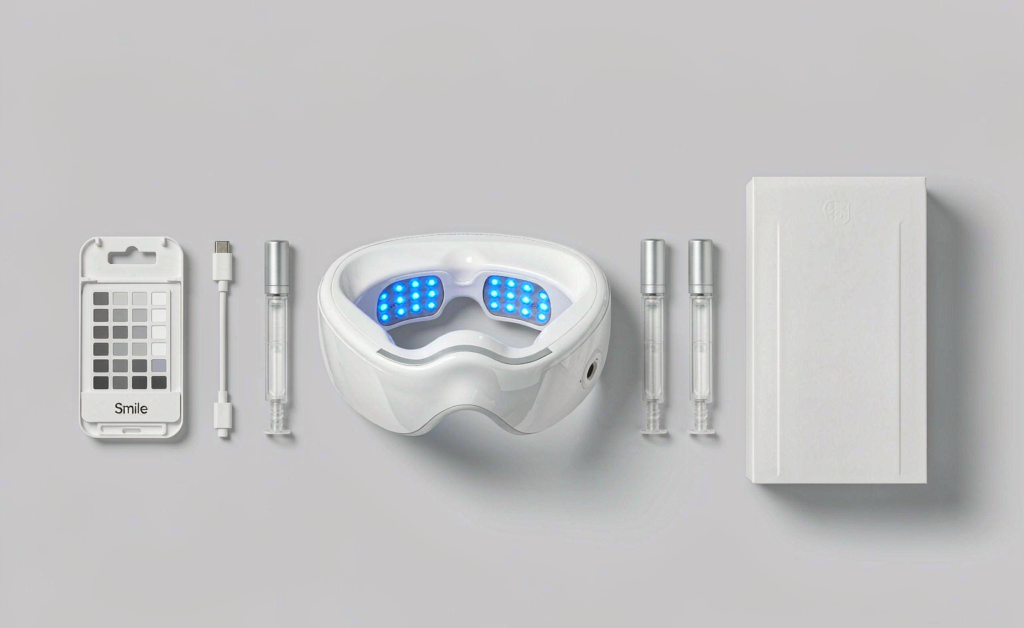
A teeth whitening kit is the best-margin SKU in most oral care catalogues and the one most likely to go wrong in production. On the retail shelf it is one box. Behind it sit two supply chains that barely speak the same language: an electronics supply chain that builds the LED accelerator unit (housing, LED array, driver board, battery, charging port, waterproofing), and a cosmetic chemistry supply chain that fills the gel syringes (peroxide system, viscosity, stability, batch coding). A whitening kit supplier who is strong at one half is frequently weak at the other, and the failure modes — a tray that stops lighting up after ten charge cycles, or a gel that arrives degraded after a summer at sea — come from the half the factory does not control well.
This guide is written for importers, brand owners, Amazon and FBA sellers, and distributors evaluating a whitening kit supplier for the first time. It covers what you are actually buying component by component, how to choose the sourcing model, the device spec sheet you should demand before any quote, battery and market compliance sequencing, why the gel refill line is the real business model, the five separate MOQs hiding inside one kit, a QC test plan for a hybrid electronic-cosmetic product, freight and landed cost considerations, and the checklist to complete before you wire a deposit.
What You Are Actually Buying: Kit Anatomy and Where Programs Fail
Before comparing quotes, break the kit into its parts, because each part carries its own supplier, its own minimum order quantity and its own failure mode. Two factories can quote “the same” LED whitening kit and ship products that differ in almost every dimension that matters.
| Component | What varies between factories | What to pin down in writing |
|---|---|---|
| LED accelerator unit | LED count and stated output, optics, housing material, IP (ingress protection) claim, charge method | LED count, stated irradiance at the tooth surface with a test method, housing material, IP rating and how it is verified |
| Battery and charging | Cell chemistry and capacity, charge time, cycle life claim, connector type | Cell specification and datasheet, cycle life test basis, overcharge and over-discharge protection features |
| Whitening gel | Peroxide type and concentration, viscosity, flavor, desensitizing agents, syringe size | Full INCI ingredient list, peroxide content as supplied and per treatment, fill weight tolerance |
| Gel packaging | Syringe vs pen vs tray-fill format, seal method, barrier performance | Syringe material declarations, seal integrity method, light and moisture barrier spec |
| Tray or mouthpiece | Boil-and-bite vs pre-formed vs universal fit, material grade | Food-contact or cosmetic-grade material declarations for everything the gel touches |
| Printed components | Shade guide, instruction leaflet, carton, claim copy | Every printed claim supportable in the market of sale, artwork handover files |
The discipline here is identical to the one we describe in our guide to private label teeth whitening strips: the chemistry is the regulated half, and the claim set on the carton must be decided together with the formula and the market. The difference is that a kit adds a second, unregulated-looking half — the device — that quietly imports all the obligations of importing any electronic product.
Step 1: Choose the Sourcing Model Before You Compare Prices
Quotes are only comparable within the same sourcing model, because tooling risk, formulation risk and certification responsibility sit in different places in each. The OEM, ODM and private label decision framework applies twice over here — once for the device and once for the gel — and the two halves do not have to use the same model.
| Sourcing model | Device half | Gel half | Best fit |
|---|---|---|---|
| Stock ODM both halves | Factory’s existing tray unit, your logo and carton | Factory’s validated stock formula, your flavor and carton | First launch, fastest to market, lowest MOQ |
| Modified ODM | Housing color, LED count, packaging, charging format from the factory’s platform | Adjusted viscosity, flavor, syringe size from a validated base | Brands that want visible differentiation without tooling risk |
| Full custom | Custom housing tooling, custom optics, proprietary electronics layout | Custom formula with stability validation and claim development | Established brands with proven demand and volume to amortize tooling |
Most first-time buyers should launch stock-ODM on both halves and differentiate through the kit bundle and packaging — the perceived value of a kit comes mostly from its completeness, not from invisible electronics. If you do go full custom on the device, read our guide to OEM contracts covering IP, tooling ownership and NDAs first: custom housing tooling is exactly the asset that becomes a dispute when the relationship sours, and the contract must state who owns the molds before they are cut.
Step 2: Write the Device Spec Sheet Before Any Quote
The gel half of the kit inherits a mature spec discipline — the toothpaste and strips industries wrote it years ago. The device half usually does not, which is why your RFQ must impose one. At minimum, require the factory to fix in writing:
- LED specification — LED count per tray, stated peak wavelength band, and the irradiance the design delivers at the tooth surface, with the test method used to measure it. Verify the numbers against the LED component datasheet, not just the sales sheet.
- Optical geometry — how the light is distributed across the arch, and whether the output claim is measured through the tray with gel in place or in free air. These are different numbers and only one of them describes the customer’s experience.
- Power architecture — battery chemistry and capacity, whether the unit is rechargeable or replaceable-battery, charge time, and the stated cycle life with the test basis behind that claim.
- Protection features — overcharge, over-discharge and over-current protection on the charging path, and the ingress protection (IP) rating claimed for the housing with the test standard used to verify it. A tray that contacts wet gel and saliva is a wet-use product whether or not the carton says so.
- Materials — housing and tray material grades, with food-contact or cosmetic-grade declarations for every surface the gel or the mouth touches.
- Timing electronics — session timer behavior, auto shut-off, and any indicator lights, so the instruction leaflet matches the hardware.
- Charging hardware — connector type, cable included or not, and any charging base or case, each of which carries its own component MOQ.
A factory that resists writing these lines down is telling you where its quality system ends. Our water flosser OEM sourcing guide covers the same dynamic for the most demanding wet-electronics product in the category, and the vetting logic transfers directly to whitening trays.
Step 3: Sequence Battery and Market Compliance Before Tooling, Not After
Compliance for a whitening kit runs on two parallel tracks, and both should be cleared before you pay for tooling — because tooling locks in the design, and the design determines what you must certify.
The device track. An LED accelerator is an electronic product, so it inherits the obligations any battery-powered consumer electronic carries in your destination market: electrical safety, electromagnetic compatibility and, if the housing makes product-defining claims about wireless features, the applicable radio rules. Battery-powered units additionally fall under transport rules for lithium cells — the factory should be able to provide the cell manufacturer’s UN 38.3 test summary, and your forwarder will ask for lithium battery documentation at booking. Which exact scheme set applies depends on the final design and destination; confirm the list with your regulatory consultant or notified body before approving the industrial design. Our battery compliance and QC guide for electric toothbrushes walks through this sequencing for the closest analog in oral care, and our CE versus FDA comparison explains why the EU and US tracks run differently.
The gel track. The gel is a cosmetic or, depending on concentration and claims, potentially a differently classified product depending on the market — the same peroxide-limit logic that governs strips, and the same warning: never let a supplier pick a formula “to match whatever is legal in your market.” The market rule comes first. Where the US pathway is unclear for your specific claim set, our FDA oral care certification guide outlines the questions to put to a US regulatory consultant before you print a carton.
One trap specific to kits: some markets treat a device-plus-gel kit differently from either component alone, because the combination creates the intended use. Ask your consultant whether the kit, the device and the gel each need their own paperwork for your destination — the answer is market-specific, and assuming it is “just the gel” is how kits get held at customs.
Step 4: The Gel Refill Line Is the Business Model
Here is the retail math most first-time kit buyers miss: the device is the customer acquisition cost and the gel refills are the profit. A customer who buys the kit once and repurchases gel every few weeks is worth several times a one-time kit sale, which is why every serious whitening brand eventually launches a refill SKU — and why your supplier conversation should treat refills as a product line from day one, not an afterthought.
Practical consequences for the buyer:
- Design the kit for refills. A kit whose syringe format matches a standard refill you can source later — including from a second supplier, if you negotiate the tooling and packaging rights correctly — keeps your replenishment line competitive. A proprietary syringe that only the kit factory can fill is a dependency, not a feature, unless you priced that dependency deliberately.
- Price the refill as its own program. Refills carry their own gel batch minimum, syringe print minimum and carton minimum — the same three-minimums logic as strips. Get those numbers quoted at RFQ stage even if refill launch is planned for later, so you know the replenishment economics before you commit to the kit design.
- Specify shelf life seriously. Peroxide gel degrades with heat, time and light. The refill you ship in month eighteen must perform identically to the kit’s included syringes, so require the factory’s written shelf life support and storage conditions, and use the terminology in our shelf life, PAO and batch code guide. Refills also spend longer in warehouses than kits do — that changes your working capital math, not just your QC math.
- Plan the documentation pack for both SKUs. COA per gel batch, SDS for the gel, INCI lists, and finished-goods inspection reports for the device — the full set is described in our supplier document set guide, and refills need their own batch-level documents because they are their own production runs.
Step 5: MOQ Reality — One Kit, Five Minimums
Buyers asking “what is the MOQ for a whitening kit” usually hear one number and later discover five. The highest binding minimum governs the program.
| Minimum | What drives it | Lever to reduce it |
|---|---|---|
| Device component minimum | LED, cell and PCBA components are purchased in mill quantities by the assembler | Choose a unit platform the factory already produces; custom electronics raise this sharply |
| Housing tooling minimum | Custom housings need mold investment, amortized over committed volume | Stay on the factory’s stock housing platform for the first generation |
| Gel batch minimum | Mixing vessel and filling line viable batch size | Use a validated stock formula; custom formulas raise this substantially |
| Syringe and print minimum | Custom-printed syringes, sachets and leaflets | Digital or low-volume printing for the first order at a higher unit price |
| Carton and kit-pack minimum | Printed cartons, inserts and kit assembly economics | Standardize carton size across your SKUs to share overstock |
A realistic first-order conversation is therefore not “lower the MOQ” but “which minimum is binding, and what does relaxing each one cost.” For a stock-ODM kit with stock gel, first orders of a few thousand kits are commonly achievable; a custom housing plus custom formula usually starts several multiples higher. If you want to validate demand before committing to any of these minimums, our ready-to-ship program offers stock whitening kits with your branding on the packaging, and our analysis of how low-MOQ oral care suppliers actually work explains the general trade-offs.
Step 6: QC Test Plan for a Hybrid Electronic-Cosmetic Product
A visual pre-shipment inspection will not catch the ways kits fail. Write a device-specific test plan into your inspection standard, alongside the standard gel checks from our AQL pre-shipment inspection guide:
- Functional check on every unit, not a sample — power on, LED illumination of the full array, timer cycle completion, and charge-port operation. This is cheap in-line and catches the single most review-destroying defect in the category.
- Irradiance verification — a sampled light-output measurement against the spec sheet figure, with the meter and method agreed in advance.
- Battery cycle sanity test — sampled units run through repeated charge-discharge cycles to confirm the unit still operates after the early-cycle failures that defective cells produce.
- Ingress protection verification — sampled units tested against the claimed IP rating, because a tray that fails in a wet mouth is a refund queue.
- Drop and vibration sampling — kits ship in mixed containers and get dropped by couriers; sample units should survive a realistic transit simulation.
- Gel batch checks — peroxide content on the COA, fill weight against tolerance, syringe seal integrity sampling, and legible batch codes on every syringe.
- Kit completeness and count — every component present, correct quantities, artwork matching the approved proof, and retained samples sealed per batch for the full shelf life period.
For any program that becomes a meaningful line of your business, add a documented factory audit before the first PO — our 12-point oral care factory audit checklist covers both the assembly floor and the filling line, which is exactly the two-room problem a kit supplier presents.
Step 7: Freight Mode Depends on the Battery, Not the Carton
The lithium cell inside the device changes your logistics more than any other kit feature. Units with installed batteries ship under different air-freight packing provisions than gel-only products, some modes and routes restrict or surcharge lithium shipments seasonally, and your forwarder will request the cell’s test summary and lithium handling documentation at booking — not at departure. Before you commit to an Incoterm, put the lithium question to your forwarder explicitly: which mode your configuration can move on, what documentation they need from the factory, and how the answer changes your cost and timeline.
This is also where landed cost discipline matters most, because a kit’s freight class, handling surcharges and clearance profile differ from a carton of toothbrushes. Model your margin on landed cost, never FOB — our DDP shipping and landed cost guide walks through the full calculation, and our HS code and customs classification guide explains why a kit containing an electronic device and a cosmetic gel may classify differently than either component alone. Never guess tariff treatment for a hybrid SKU — confirm the classification with your customs broker before you quote your retail price. Timing matters too: device programs add component procurement and certification steps to the standard production calendar, so build the buffer in using our lead time breakdown, and tie document delivery to payment milestones as described in our payment terms guide.
Pre-PO Checklist for a Whitening Kit Program
Before you wire a deposit, every line below should be closed:
- [ ] Sourcing model chosen separately for device and gel, and all quotes priced within the same model
- [ ] Device spec sheet (LED spec, battery, IP rating, materials, timer) signed by both parties
- [ ] Gel spec sheet with peroxide system, INCI list, fill weight tolerance and shelf life support in writing
- [ ] Destination market rules for both the gel and the kit confirmed with your regulatory consultant
- [ ] Battery transport documentation (cell test summary, lithium handling docs) confirmed available from the factory
- [ ] All five MOQs priced, with the levers to relax each one priced too
- [ ] Golden sample approved and referenced in the PO — see our golden sample versus PP sample workflow
- [ ] Tooling ownership stated in the contract if any custom housing is involved
- [ ] Inspection standard includes functional LED, battery cycle, IP and gel batch checks against an agreed AQL
- [ ] Refill SKU economics quoted, even if the refill launches later
- [ ] Freight mode and lithium restrictions confirmed with your forwarder, Incoterm agreed
- [ ] Documentation pack (COA, SDS, INCI, COC, inspection reports) tied to payment milestones
FAQ
What MOQ should I expect from a whitening kit supplier?
Expect five separate minimums — device components, housing tooling, gel batch, syringe printing and carton printing — and the highest one governs. A stock-ODM kit with a validated gel formula commonly starts in the low thousands of kits, while a custom housing or custom formula raises the entry point substantially. Ask suppliers to quote each minimum separately, because that is the only way to see which one is binding and what it costs to relax it.
Can I source the LED device and the gel from two different factories?
Yes, and for programs at volume it is often the stronger structure, because few factories excel at both electronics assembly and cosmetic filling. The trade-offs are kit-assembly responsibility, split warranty liability and coordinating batch documentation across two production lines. If you split the program, your contract must state who performs final kit assembly, who owns the golden sample for each half, and which party holds the compliance files for the finished kit.
Do whitening kits need certification for the device as well as the gel?
In most destination markets, yes — the LED unit is a battery-powered electronic product and carries the applicable electrical safety, EMC and lithium battery transport obligations, while the gel follows cosmetic (or, in some markets and for some claims, differently classified) product rules. The exact scheme set depends on the final design and destination, and kits can be treated differently from their components, so confirm the full list with your regulatory consultant before approving tooling.
How do I keep customers repurchasing after the kit sale?
Design the refill line into the program from day one: a syringe format you can source competitively, a gel formula with documented shelf life, and refill MOQs quoted at RFQ stage even if the launch is later. Replenishment is where the category’s margin lives, and brands that treat refills as an afterthought usually discover their kit design locked them into a single supplier at unfavorable prices.
Work With LMS Oral
Sourcing a whitening kit means running two supplier evaluations in parallel — an electronics program and a cosmetic chemistry program — and the buyers who win are the ones who pin the spec, the compliance sequence and the refill economics before comparing prices. LMS Oral manages whitening kit programs across both halves: device sourcing with functional QC and battery documentation, gel formulation and filling with batch-level COAs, AQL pre-shipment inspection on the finished kit, and documentation support for your destination market.
- Start a program on our OEM service page
- Need stock this quarter? See the ready-to-ship whitening kits
- Email sales@lmsoral.com with your spec sheet or RFQ
- WhatsApp +86 17703320885 for a same-day quote conversation
We quote against written specifications, and we will tell you honestly when a kit design does not fit your market or your replenishment plan — before it becomes a customs problem.
Interested in sourcing oral care products?
Contact us for a free consultation and quote.
Contact Us →