Third-Party Lab Testing for Oral Care Imports: What to Test, Who Pays, and How to Verify the Report
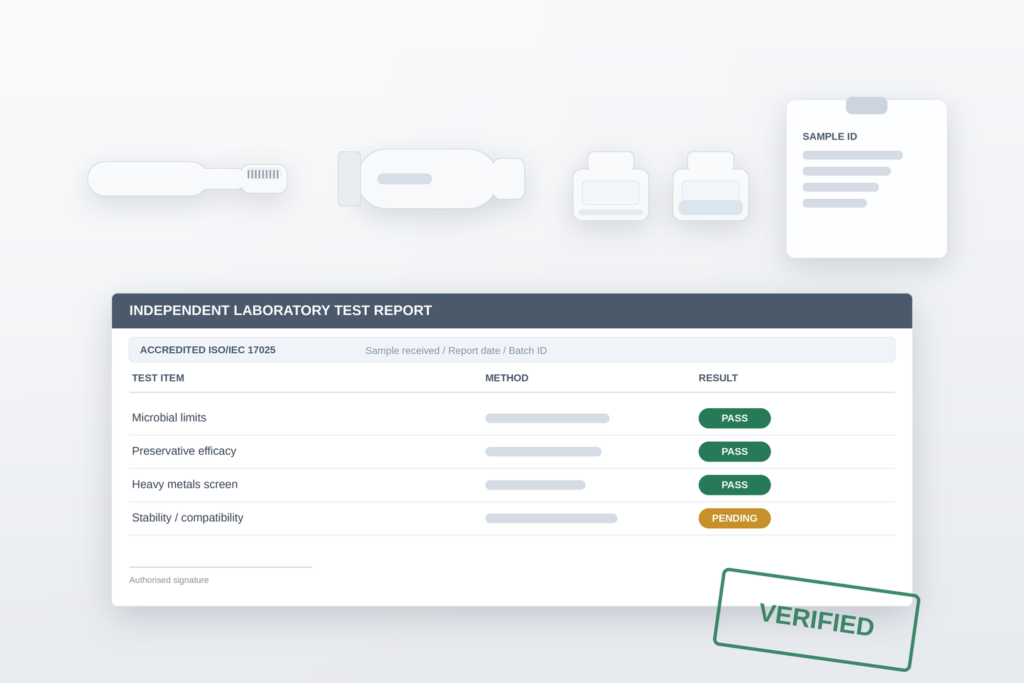
Most importers treat a test report as paperwork: something the supplier attaches to the proforma invoice, something the broker may or may not ask for, something that gets filed and forgotten. Then a marketplace pulls a listing, a retailer’s compliance team asks for a full report with an accreditation number, or a container of toothpaste arrives with separated paste — and the report turns out to be the only document that decides who eats the loss.
This guide is written for the buying side. It covers when to commission your own third-party lab testing for oral care products, which tests each product category actually needs, how the cost and lead time fit into your production calendar, and — the part most buyers skip — how to verify that a report is real, current, and tied to the batch you are buying.
Why Buyers Commission Their Own Testing When the Supplier Already Sent a COA
A Certificate of Analysis tells you the manufacturer’s own lab (or a lab the manufacturer hired) tested a batch and got a result. That is useful, and it is also a statement of interest: the same party that needs the shipment to pass is the party that ran the test.
Independent testing solves a different problem. You are not re-checking whether the factory can run a pH meter — you are buying an evidentiary record you can stand behind with a retailer, a marketplace, an insurer, or a customs authority. Concretely, third-party lab testing for oral care earns its cost when:
- A retailer or marketplace requires it. Amazon, drugstore chains and pharmacy groups increasingly ask for an accredited-lab report rather than a supplier COA before approving a private-label listing.
- You are moving to a new supplier or a new formula. One clean independent report on the golden sample becomes the reference point for every future dispute.
- The product category carries higher liability. Anything with a battery, a motor, an electrical charging circuit, a whitening active, or a claim about enamel repair sits in higher-risk territory than a plain manual brush.
- You changed one input. New bristle supplier, new tube laminate, new fragrance, new contract manufacturer — each is a re-test trigger, not a “same product” assumption.
- You are financing inventory. Lenders and inventory insurers are far more comfortable when an accredited report exists.
If none of those apply and you already have a stable supplier relationship, a supplier COA plus your own pre-shipment QC inspection may be proportionate. Testing is not a substitute for inspection, and inspection is not a substitute for testing: inspection checks the cartons in front of you, testing checks the material and the chemistry.
The Oral Care Test Matrix by Product Category
Scope is where budgets get wasted. Buyers either test nothing or ask for “full testing,” which usually means a lab invoice padded with assays that no regulator in the destination market asked for. Start from the product, then from the market.
| Product | Core tests buyers typically commission | Why it matters commercially | Usually triggered by |
|---|---|---|---|
| Toothpaste / dentifrice | Microbial limits & preservative efficacy, stability, pH, viscosity, heavy metals, fluoride or active assay, tube compatibility | Separation, grittiness, off-odour and fluoride shortfall are the top claim drivers | New formula, new tube laminate, new market |
| Manual toothbrush | Tuft retention / bristle pull-out, handle flexural strength, head impact resistance, filament end-rounding, material ID | Broken handles and shed filaments generate returns and “poor quality” reviews | New filament supplier, new handle resin |
| Kids’ toothbrush | All manual tests plus small-parts / sharp-point checks and migration on coloured or printed parts | Toy and child-safety exposure sits above normal oral care risk | Every new SKU, every artwork change |
| Electric toothbrush | Electrical safety, battery and charging safety, IP/water-ingress rating, EMC, bristle tests | Electrical non-compliance can block the listing outright | New platform, new battery cell, new charger |
| Water flosser | Electrical safety, IP rating, tank material and leaching, pressure/pulse performance verification | Water + mains voltage is the highest-consequence combination in the category | New model, new motor supplier |
| Mouthwash / oral rinse | Microbial limits, preservative efficacy, ethanol content, stability, pH, packaging compatibility | Alcohol content affects classification, freight class and retail acceptance | New formula, new market |
| Dental floss / interdental | Tensile strength, shredding resistance, material ID, microbial limits for coated variants | Weak or shredding floss drives repeat-purchase collapse | New filament or coating supplier |
| Whitening products | Peroxide or active content assay, stability, packaging compatibility, pH | Active concentration is both an efficacy and a compliance issue | Every batch in some markets; confirm locally |
Two caveats worth stating plainly. First, the standards a lab cites have edition years — ask which version a report is tested against and confirm that version is still current for your destination market. Second, jurisdiction-specific requirements change, and this table is a commercial scoping tool, not a legal checklist. Confirm the exact mandatory list for your market with your compliance adviser or customs broker before you pay for testing; for the certification side of that work, see the 2026 oral care export compliance checklist and CE vs FDA for oral care products.
What Each Test Tells You — and What It Quietly Doesn’t
Understanding the limit of each test is what stops buyers from over-trusting a clean report.
- Microbial limits testing tells you the batch as submitted was not contaminated. It does not tell you the batch will stay that way through a hot container crossing. Pair it with preservative efficacy data.
- Preservative efficacy (challenge) testing tells you the formula can resist contamination over its life. It is a formulation test, not a batch test — one good challenge test does not cover a later formulation tweak.
- Stability testing tells you how the product behaves over time under defined conditions. It takes the longest of any test on this list, which is why it must be started before you need the result, not after.
- Heavy metals and restricted-substance screening tells you about the batch tested. Recycle this test whenever an input supplier changes.
- Electrical safety and IP rating tell you about the specific model and its specific components. Change the battery cell or the charger and the report is no longer describing your product.
- Material identification confirms resin or filament family. It is cheap and it is the fastest way to catch a silent downgrade from nylon to a cheaper substitute.
Note what is missing from that list: none of these tests confirm the packaging artwork, the carton count, or the batch coding. Those are inspection and documentation items — see COA, SDS, TDS, COC: which documents to request and shelf life, PAO and batch code rules.
Cost, Lead Time and Who Pays
Nobody can quote your testing bill in a blog post, because fees depend on the lab, the accreditation scope, the number of analytes and whether the test needs to be run from scratch or against an existing method. What buyers can plan on is the shape of the cost and the schedule.
| Dimension | What to plan for | Buyer-side note |
|---|---|---|
| Fee level | Microbial limits and material ID sit at the low end; stability and full electrical safety sit at the high end | Ask for a written, itemised quote per analyte; bundled “full package” pricing hides what you actually need |
| Sample quantity | Labs need multiple retail units plus, for some tests, bulk material | Add the sample pull to your PO so the factory cannot claim it was never budgeted |
| Lead time | Microbial and physical tests are days; stability and challenge testing run in weeks or months | Stability is the one that breaks launch calendars — start it at golden sample stage, not at PP stage |
| Rush options | Most labs offer expedited handling at a premium | Budget the premium; a two-week delay on a seasonal launch costs more than the rush fee |
| Who pays | First-article testing is usually buyer-paid; batch testing for a buyer-mandated requirement is usually supplier-paid and priced into the unit cost | Decide this before the PI is issued, not during the dispute |
The payment question deserves a hard rule. If you mandate a test as a condition of purchase, the supplier will eventually price it into your unit cost — which is fine, but it should be visible, not hidden. If instead you treat testing as your own due diligence, budget it as a sourcing cost and keep ownership of the report. Either is defensible; ambiguity is not. Get the allocation into the OEM agreement alongside tooling and IP terms, as covered in oral care OEM contract, IP, tooling and NDA basics.
How to Verify a Test Report Before You Accept It
Treat a report like a negotiable instrument, not a PDF. Before you file it, check these six things:
- Accreditation. The report should name the lab and carry an accreditation reference (ISO/IEC 17025 is the standard buyers look for). Check the accreditation covers the specific test method cited.
- Scope match. The product description, model number and specification on the report must match what you are buying — not a “similar” SKU from the same factory.
- Batch traceability. A batch or lot number that ties to your production, plus a sampling date. A report without a sample receipt date is weak evidence.
- Date and validity. Compare the issue date against your shipment. An old report is not automatically invalid, but you should be able to explain why it still applies.
- Internal consistency. Page count, page numbering, fonts, and the result table should be internally consistent. Edited or recycled reports often show mismatched fonts, missing page numbers, or a scope line that was changed without changing the result table.
- Result against your spec, not just against a standard. “Pass” means pass against the standard the lab tested to. Check the actual numbers against the specification you wrote into your toothpaste spec sheet or bristle spec sheet.
Where the report was issued by the factory’s own lab, ask for the raw data file rather than a summary certificate. Legitimate labs are used to this request; resistance to it is itself a signal, and it belongs on your supplier scorecard.
Writing Testing Into the PO and the OEM Contract
Testing only protects you if it is contractually anchored. Four clauses do most of the work:
- Sample retention. Both parties retain sealed retention samples from the tested batch for a defined period, so a later dispute can be re-tested rather than argued.
- Test-trigger list. A defined list of changes (formula, material, component, subcontractor, manufacturing site) that automatically voids the existing report and requires re-test.
- Cost and ownership allocation. Who pays for which test, and who owns the report. Owner decides who can show it to a retailer.
- Failure remedy. What happens on a failed result: rework at supplier cost, replacement, or refund — and who bears freight and disposal. Link this to your failed inspection and claims playbook so the remedy path is the same one you already use.
For higher-risk categories, pair the contract language with product liability insurance for importers. Testing reduces the probability of a claim; insurance reduces the size of one.
When One Report Stops Being Valid
Re-test triggers are where disciplined buyers save real money, because they stop you from testing everything forever while still catching the changes that matter. Re-test when you change: the formula or any active level; the filament, resin or laminate supplier; the battery cell, motor or charger; the manufacturing site or subcontractor; the target market with a different regulatory regime; or the packaging in direct product contact. Do not automatically re-test for artwork changes on outer cartons, quantity changes within the same production run, or a freight-routing change — those are Incoterms and logistics questions, not lab questions.
Note the interaction with classification: a change that moves your HS code almost always changes your compliance obligations, and therefore your test scope. And if you are qualifying a factory from scratch, sequencing matters — run your factory audit first, because a lab cannot fix a process that is not under control.
FAQ
Is a supplier-issued COA enough, or do I really need third-party lab testing for oral care products?
For an established supplier and a repeat SKU with no changes, a COA plus your own pre-shipment inspection is usually proportionate. Commission independent testing for a new supplier, a new formula, a new market, or any listing that requires an accredited report.
Who should pay — buyer or supplier?
First-article and qualification testing is normally buyer-paid because the buyer owns the decision. Once a test becomes a standing condition of your POs, suppliers typically absorb it into unit price. Write the allocation into the contract before the PI, and expect it to show up in your landed cost either way.
How long does testing take, and will it delay my launch?
Microbial and physical tests are measured in days; stability and preservative efficacy are measured in weeks to months. The delay risk is almost always stability testing started too late. Start it at golden sample stage, not at pre-production.
What is the single most common problem you see in test reports?
Scope drift: the report describes a product that is close to, but not exactly, what is being shipped — a different tube laminate, a different battery cell, a different filament. Compare the report’s product description line-by-line against your spec sheet before accepting it.
Should I re-test every production batch?
No. Test at qualification, then on defined change triggers, then periodically as a surveillance check. Batch-by-batch full testing is rarely commercially justified outside active-content claims.
Does testing replace a pre-shipment inspection?
No. Inspection checks the cartons, quantities, artwork and workmanship on the specific shipment. Testing checks the material and chemistry. They catch different failures and you need both. Electric and motorised categories need the most overlap — see electric toothbrush OEM compliance and QC and the water flosser OEM sourcing guide.
Get a Test Scope Review Before You Spend on It
If you are sourcing oral care products from China, the cheapest testing programme is the one scoped correctly the first time. Send us your product list, target market and current spec sheets, and we will tell you which tests are genuinely required, which are commonly oversold, and how to write the cost and ownership terms into your PO.
We support both routes: full OEM / ODM development for private-label programmes, and ready-to-ship stock for buyers who need to move before a seasonal window closes.
Email: sales@lmsoral.com
WhatsApp: +86 17703320885
Interested in sourcing oral care products?
Contact us for a free consultation and quote.
Contact Us →